
Stress Fractures Treatment
Stress fractures can manifest in any bone in the body. However, they most commonly occur in the feet, where the concentrated weight of the body places additional strain on these bones. They are a common and debilitating condition affecting both men and women, particularly those participating in high-impact activities. Their fractures typically result from the repetitive stress and overuse of bones in the foot, which can lead to excruciating pain and hinder their ability to enjoy sports and physical activities.
The injuries typically occur when muscles become fatigued and can no longer absorb the increased shock from strenuous activities. Consequently, the exhausted muscles transfer excessive stress to the bones, resulting in stress fractures.
Additionally, stress fractures are often triggered by factors like sudden changes in surface conditions, such as a tennis player switching from a soft grass court to a hard court, or the use of inadequate footwear, such as worn-out trainers. Football players frequently suffer from stress fractures impairing their performance on the field. Many people have successfully overcome stress fractures through innovative treatments like focused Shockwave therapy and Magneto Transduction Therapy, allowing them to return to their sports quickly.
Our Shockwave Treatments
Achilles Tendonitis
Back Pain
Carpal Tunnel Syndrome
Dupuytren’s Disease
Golfer’s Elbow
Gout
Hip Pain
Knee Calcification
Medial Tibial Stress Syndrome
Morton’s Neuroma
Osgood-Schlatter Disease
Patellar Tendinitis – Jumpers Knee
Pseudarthrosis
Scar Tissue Treatment
Shoulder Calcification
Shoulder Tendinitis & Bursitis
Stress Fractures
Tennis Elbow – Lateral Epicondylitis
Therapy for Diabetics with Frozen Shoulder
Trigger Finger
Stress Fractures Treatment
Patients diagnosed with stress fractures are advised to rest from the activity that initially caused the injury. The healing process generally takes six to eight weeks. However, in some cases, it may be longer. It is of utmost importance to adhere to the recommended rest period as failure to do so can result in the development of larger and more challenging-to-heal stress fractures.
Rest: This is paramount. The bone needs time to heal, and continuing to place weight or stress on it can worsen the fracture. Activities that put stress on the affected bone, particularly impact activities, should be avoided.
Ice: Applying ice can help reduce swelling and provide some pain relief. Use a cloth or towel between the ice and skin to prevent frostbite. Typically, icing for 20 minutes every hour when awake during the initial stages is recommended.
Pain Relief: Over-the-counter pain relievers, such as ibuprofen, can help manage pain.
Support: Immobilization with a brace or cast can protect the bone and give it a chance to heal. For fractures in the foot or lower leg, crutches might be recommended to offload weight from the affected limb.
Footwear and Orthotics: Proper footwear can provide support and distribute weight evenly, reducing stress on the bone. Custom orthotics might be recommended to offer additional support and alignment. You can find out more about these on our Footstepz site.

Shockwave Therapy & Stress Fractures Treatment Research
Surgical stabilisation may be the final treatment for Stress Fractures, but it is a highly invasive procedure with known complications.
In an article published in the International Journal of Surgery it was reported that “shockwave treatments (ESWT), based upon the stimulation of bone turnover, osteoblast stimulation and neovascularization by mechanotransduction, has been successfully used to treat delayed unions and avascular necrosis. Since 1999 it has also been proposed in the treatment of stress fractures with excellent results and no complications. Research using focused shockwave treatments in professional athletes and military personnel showed a high rate of recovery allowing them to return to competition and control pain.”
They concluded by recommending it as the primary standard of care in low risk patients with poor response to conventional treatments.
These studies are in line with our own experience of successfully treating patients with stress fractures.

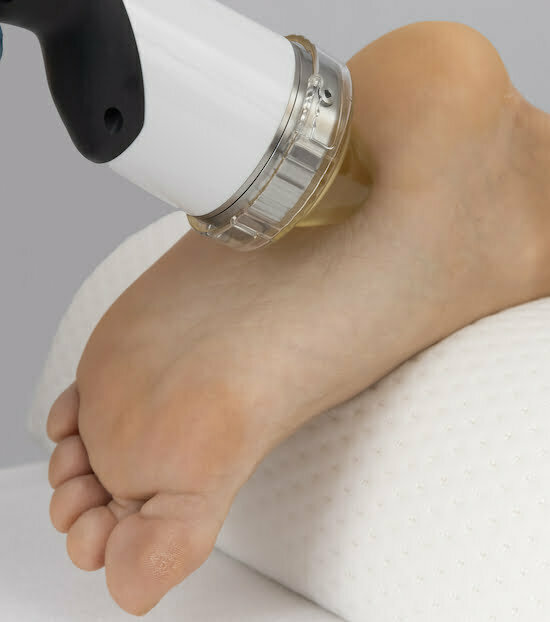
We administer EMTT through a handheld device that is placed over the affected area. The treatment is painless and non-invasive, and typically takes just a few minutes to complete. Patients may receive several EMTT sessions over the course of a few weeks, depending on the severity of their symptoms and the extent of their injury.
EMTT works by generating electromagnetic fields that penetrate the skin and underlying tissues. These fields can stimulate the production of growth factors and other signalling molecules that promote tissue repair and regeneration. EMTT can also help reduce pain and inflammation by increasing blood flow and reducing the activity of pain receptors in the affected area.
We are one of the few clinics in the country offering this as a solution to this painful condition and we recommend you book an appointment soon.
EMTT Therapy for Stress Fractures Treatment
We are now using ElectroMagnetic Transduction Therapy (EMTT) in conjunction with Shockwave therapy as we have found the combination of the two treatments especially effective for dealing with Stress Fractures.
EMTT is a non-invasive treatment that uses electromagnetic waves to stimulate healing in the affected area. The treatment works by producing a pulsed electromagnetic field that penetrates the tissues and stimulates cellular activity. This increased cellular activity can help to reduce inflammation, increase blood flow, and promote tissue repair.
A recent in vitro study by Gerdesmeyer et al. (1) provided new findings from basic research relating to EMTT. The objective of the study was to determine the cell-stimulating effects of EMTT on bone marrow mesenchymal stem cells and thereby draw conclusions regarding the benefit of EMTT in healing bone fractures.
The authors of the study investigated the effect of EMTT on human bone marrow mesenchymal stem cells (MSCs) by simulating a 10-minute outpatient treatment (three times per week) over a total period of two weeks. On day seven of the treatment, the test showed a significantly higher VEGF concentration in the EMTT group treated with 80 mT versus the untreated control group.
One of the major advantages of EMTT is that it is a non-invasive treatment that does not require any medication or surgery. This makes it a safe and convenient treatment option for patients who are looking for a non-invasive alternative to more invasive treatments.
ABOUT SHOCKWAVE CLINICS
Shockwave Clinics Ltd is the leading shockwave clinic in London and the UK with the most advanced and comprehensive range of shockwave and complimentary technologies, including magneto transduction therapy and radio frequency.
For over 10-years we have been using Focused Shockwave to treat numerous muscular problems caused by sports injuries as well as back pain, problems caused by invasive surgery and simple old age.
